Answer records, a book that may be the Rosetta Stone of rock’n’roll and . . . . finally, Nolan Strong and the Diablos.
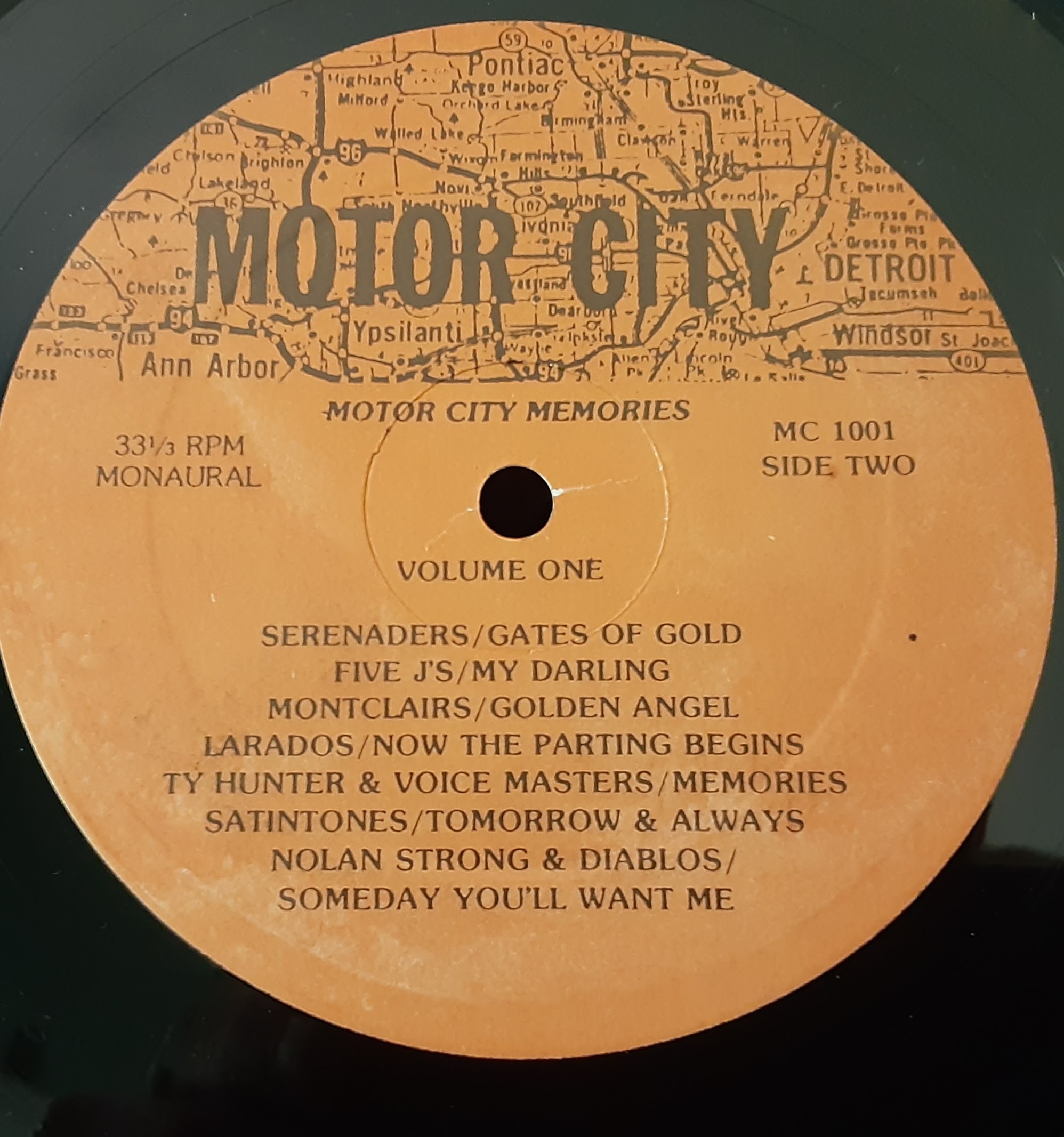
It’s taken a while but here are notes on Side 2 of Vol. 1 of Motor City Memories.
For those who missed my post on Side 1, here is link: Motor City Memories Vol. 1 LP – Review and Guide.
The first post provides background on the LP, label, sources, etc., so best to read that first if you care about that stuff.
While side 1 of the LP is all uptempo songs, side 2 is ballads/slow songs. Where the 45 credits are different than indicated on the LP, I have included that information.
Here is a list of sites that have been sources for this and the prior posts:
- All Music
- Marv Goldberg’s R&B Notebooks
- SoulfulDetroit.Com
- Detroit Soul Singles
- Val Shively’s R&B Records
- PJDooWop’s YouTube Channel
- Doo Wop
- Sebear Studios
All of these songs can be listened to on YouTube, usually in the preferred format (an actual video of the 45 being spun).
- Here is a link to a playlist I created of all the songs (on both sides) on my YouTube channel – perfect accompaniment to the post!
Now, on to the tracks on side 2.
Track 1 – The Serenaders – Gates Of Gold
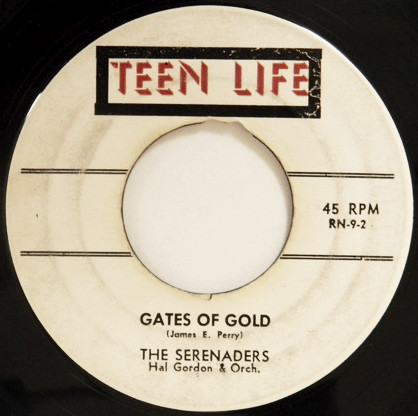
Label: Teen Life – RN-9-2 (Credited to The Serenaders – Hal Gordon & Orch.)
Date: 1958
Composition: James E. Perry
A-Side: Love Me Now
- There were several Serenaders groups. This one was a New York-based group that eventually cut their final single on Motown’s VIP label. This is not The Serenaders from Detroit who became the Royals and then the Royal Jokers.
- This record is not listed in Discogs, and not mentioned in the various bio’s online for The Serenaders. However, it can be found on 45Cat.com, as the B-side of Love Me Now, also written by James Perry.
- Background on the group, summarized from Doo Wop site:
- Forming in 1956, the central figures were George Kerr, Sidney Barnes and Timothy “Andre” Wilson. Howard Curry is on this record, according to other sources.
- They debuted on Chock Full of Hits records with “Never Let Me Go” b/w “I Wrote a Letter” in 1957. They went on to record for several other labels (MGM, Cross Country, Rae-Cox, Teen Life, Riverside) but never sold well outside the New York/Jersey/Philly area.
- The Motown connection came when the Serenaders were signed by Raynoma Gordy (Berry Gordy’s business partner and second wife) out of Motown’s New York office. Motown finally released the Serenaders’ “If Your Heart Says Yes,” a Kerr/Barnes composition, on its VIP label in 1964, but the record did not do well. Shortly after this, The Serenaders broke up.
- Timothy Wilson married Raynoma’s sister Alice; Wilson previously sung with Tiny Tim & the Hits on Roulette records. Sidney Barnes did some solo’s and got into producing, as did George Kerr who was more successful, producing Linda Jones’ “Hypnotized,” and stellar sides for the Whatnauts, the O’Jays, the Moments, Lonnie Youngblood, and others, in addition to singing with Little Anthony & the Imperials on their New Time recordings.
- A very rare record per PJDooWop, which has been cited at $800-$1200 for a mint copy.
Listening Notes:
- A beautiful ballad
- Sung in an old-school style, reminiscent of The Harptones, Spaniels, Sonny Till
Track 2 – The Five J’s – My Darling
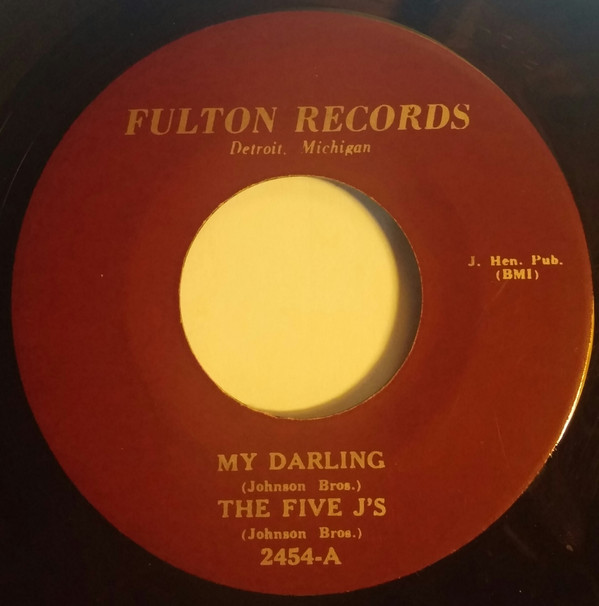
Label: Fulton 2454
Date: 1958
Composition: Johnson Bros.
B Side: Calypso Jump
- The Johnsons recorded as the 5 Johnson Brothers, the Five’s J’s and the Johnson Brothers.
- These are the same Johnson Brothers who sang backup on Cornell Blakely’s “Promise to be True” on side 1.
- Not a lot of info out there about this group.
- Fulton Records was owned by Charles Fulton and James Hendrix and started around 1958. The label released records by Cornell Blakely, Doug Kerr, the Derringers and others.
- A Very Good (i.e., non-mint) copy is listed on Discogs for $40.
- Note that this record is not on Val Shively’s list – but Fulton 2453 (Cornell Blakely) and 2455 (5 Johnson Bros) are, at $150 and $200 respectively.
Listening notes:
- I like this song a lot; it has a funky, soulful sound
- Old style R&B ballad, with emphasis on the B(lues).
- Definite blues style in the guitar and piano accompaniment.
Track 3 – The Montclairs – Golden Angel
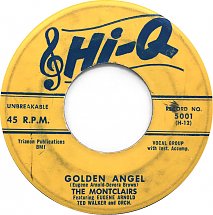
Label: Hi-Q – 5001 (Credited to The Montclairs, Featuring Eugene Arnold, Ted Walker and Orch.)
Date: 1957
Composition: Eugene Arnold and Devora Brown
B side: Don Juan
- Eugene Arnold sang lead.
- Co-Author was Devora Brown, who co-owned Fortune Records with husband Jack Brown.
- Hi-Q was a subsidiary of Fortune.
- This was the only Fortune-related side released with The Montclairs name coming before the lead singer’s.
- Other Fortune/Hi-Q sides featuring The Montclairs (listed by release number):
- Hi-Q 5010 – Jim Sands & The Montclairs – You Don’t Know My Mind / We’re Gonna Rock – 1958
- Fortune 212 – Jim Myers and his Gems with The Montclairs under direction of Devora Brown – Oh! Baby Baby / Blue Stroll – 1960
- Fortune 540 – Floyd Smith w/ The Montclairs – Grandpa’s Gully Rock / This Is A Miracle – 1961
- It must have been nerve-wracking to be The Montclairs and wonder how your name was going to appear on the label.
- Prices for Very Good/Near Mint copies range from $125-200.
- Other than many warnings to not confuse these Montclairs with the ones from New Jersey or East St. Louis, there is not a lot of information readily available about this group.
- In researching, I came across a Facebook post from 2013 that sought information on the group, from Billy Miller, the cofounder of Norton Records:
- “Can any of you folks help me out? I’m trying to track down any surviving members (or relatives) of the Montclairs for the Fortune book that Michael Hurtt and I have been working on. Any time I ask a doo-wop collector, they try to hook me up with the Montclairs on Premium which is a totally different group. Several Fortune artists that we’ve spoken to remember them as “nice guys” but we really need to interview them or speak to family members. Not looking for discography info. We have all that.”
- And this book does now exist, apparently available for $100 – “Massive 576 pages – full color – hardcover – ltd first edition”. I’ll probably have a copy soon.
Listening Notes:
- Sweet-voiced singer: quavering tone brings to mind Aaron Neville.
- Nice falsetto and harmony,
Track 4 – The Larados – Now The Parting Begins
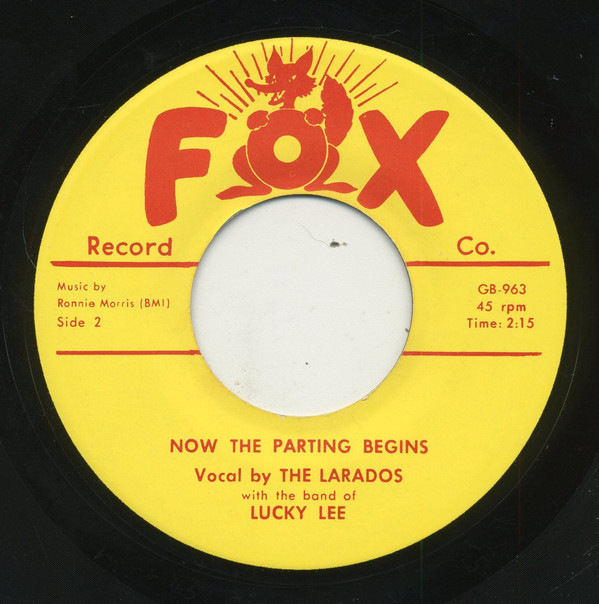
Label: Fox Record Co. GB-963 (credited as “Vocal by The Larados with the band of Lucky Lee”)
Date: 1958
Composition: Ronnie Morris
A-Side: Bad Bad Guitar Man
- Personnel on this cut: Don Davenport, Bob Broderick, Tommy Hurst, Bernie Turnbull and Ron Morris.
- From Discogs:
- “Forming at Edsel High in Dearborn, MI, the Larados used the school’s staircases, hallways, and restrooms to provide the echo for their harmonies. Initially active for five years from 1955 to 1960, they could only muster one release, “Now the Parting Beguin,” a classic doo wop, b/w “Bad Bad Guitar Man” on Fox Records in 1957.” [Ed. NOTE: “Bad Bad Guitar Man” was the A-side.]
- From Mitch Rosalsky (Encyclopedia of R&B and Doo-wop Vocal group), cited on DooWop site:
- “They were friends of the Diablos, coming from the same locale. When the group visited the Fortune records facility in Detroit, they met with Jack Brown, who owned Fortune Records with wife Devora. By pointing his finger arbitraly at a map, he named the group the Larados by pointing at Laredo, Texas (ED NOTE: and then deciding to replace “e” with “a”???). This was early in 1955.
- “Phil Waddell became their manager. He also managed the Five Scalders on Drummond. Waddell became interested in the Larados because they had such a tight black sound. Previously Waddell had handled only black vocal groups, and the white but black-sounding Larados presented a challenge to Waddell.
- “Early in 1956 the original group broke up, but one member, Gary Banovetz, met several other singers from another group that had recently split up. These singers teamed up and practiced a great deal. but later in 1956 Banovetz left and was replaced by Don Davenport, Bass from the Romeos on Fox.
- “The Larados were then asked to record for Fox Records. This was 1957 and they recorded four tunes for Fox, but only two were released and met with limited local success.
- “They then went to New York looking for someone to assist them. They went to the Apollo Theater, but Apollo Management would not accept them because they were white!
- “They appeared on Arthur Godfrey’s talent scouts show, but neither Godfrey nor his audience cared for them and they returned to Detroit. They made many live appearances in trade for radio airplay. Broderick left and Banovetz returned to perform with the group doing backup for a female Artist at Fox.
- “The Larados later became The Reflections on Golden World.”
Listening Notes:
- Bells intro
- Spoken section with falsetto over
Track 5 – Ty Hunter And Voice Masters – Memories
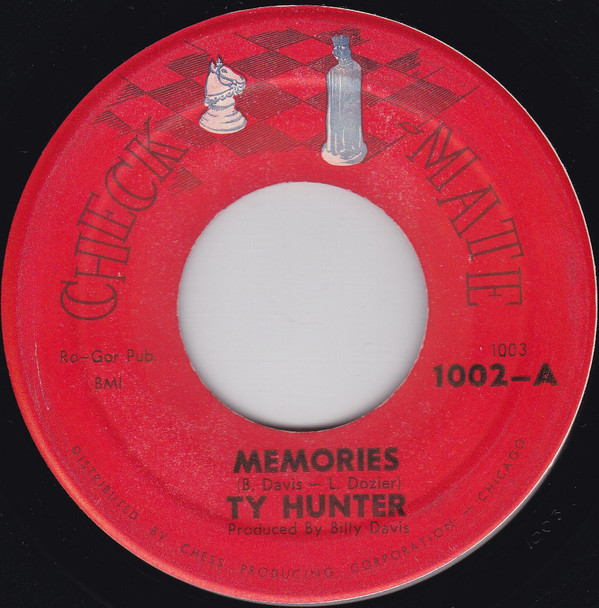
Label: Check-Mate 1002-A (Credited to Ty Hunter, no mention of Voice Masters)
Date: 1961
Composition: B. Davis and L.Dozier
B side: Envy of Every Man
- You may recall that side 1 of this LP included “I Didn’t Know” by Lamont Anthony and the Voicemasters (Checkmate 1002); and that the record credits did not mention the Voicemasters either.
- This side, like “I Didn’t Know”, was produced by Billy Davis and Lamont Dozier
- From AllMusic biography by Andrew Hamilton:
- “The Voice Masters evolved from the Five Jets and the Five Stars and were one of the first groups that Berry Gordy used on sessions. Core members Crathman P. Spencer, Walter Gaines, and Henry Dixon were led by the dynamic leads of David Ruffin, Ty Hunter, Joe Charles aka Joe Murphy, and Lamont Dozier. Melvin Franklin’s booming bass is heard on early releases, and female voices are as prominent as males on some recordings.
- “The Five Jets recorded on Deluxe Records from 1953-1954 and released one single as the Five Dollars on Fortune Records in 1957; the Five Stars emerged in 1957, cutting at least four singles on as many labels. By 1959 they were the Voice Masters and signed to Gwen Gordy and Billy Davis’ Anna Records.
- “When Billy Davis, aka Roquel and sometimes Tyran Carlo, left Anna to form Checkmate Records, the Voice Masters “.followed. The first release features Dozier [as La Mont Anthony] on the romping “I Didn’t Know
- “On this cut, they accompanied Ty Hunter on “Memories.”
Listening Notes:
• Falsetto, vibrato ballad
• Cliches – e.g., silvery moon
• Impressions style (C. Mayfield) – Gypsy woman tempo and drums
Track 6 – The Satintones – Tomorrow & Always
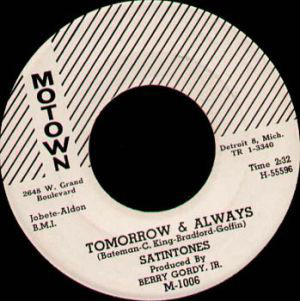
Label: Motown M-1006
Date: 1961
Composition: Bateman-King-Bradford-Goffin
B-Side: A Love That Can Never Be
- Spoiler: This record is a thinly-disguised version of The Shirelle’s hit “Will You Still Love Me Tomorrow?” (with slightly different lyrics), with plausible deniability provided by the idea that it was an “answer record”.
- The “Answer Record” is another R&B trope. Example: Hank Ballard and the Midnighter’s “Annie Had a Baby” as an answer to their own hit “Work with Me Annie”.
- This is the only actual Motown record on this LP.
- There were two versions of this song put out within a few weeks in April 1961. The first was a duet, featuring James Ellis and Vernon Williams on lead vocals; the second was a slightly slower version that sounds even more like the Shirelles hit, with strings added, and a solo vocal by James Ellis The latter version is the one on this LP.
- Lawsuits quickly followed and the record was withdrawn, and the same catalog number (1006) was used with “Angel” replacing the offending song as the A side (just to confuse future R&B discographers).
- From their All Music biography by Andrew Hamilton:
- “The Satintones were Motown’s first group, recording for the company from 1960 through 1961 and releasing six singles. This was during Motown’s blues and mundane R&B era, and before the arrival of the jazz-based rhythmic backing of the Funk Brothers; a time when Ivy Joe Hunter led the session musicians, not Earl Van Dyke; a period when Motown released nine bad records for every good one; and a time when disc jockeys cringed at 45s sporting the Tamla or Motown logo.
- “The original group was a quartet consisting of Charles “Chico” Leverett, Sonny Sanders, James Ellis, and Robert Bateman. Chico sang with the Spinners for a minute, and recorded “Solid Sender” on Tamla Records.
- “They became a quintet in 1961, the new lineup consisting of James Ellis, Sonny Sanders, Vernon Williams, Sammy Mack, and Robert Bateman.
- “All the members enjoyed musical careers before and after the Satintones with the most distinguishing belonging to Sonny Sanders, who went on to become an arranger and songwriter at Ric Tic/Golden World Records then moved to Chicago, becoming a top arranger and co-writing “Love Makes a Woman” for Barbara Acklin. Bateman produced and wrote Wilson Pickett’s early solo sides “It’s Too Late” and “If You Need Me,” jump-started the Marvelettes’ career with “Please Mr. Postman” and “Playboy,” and co-wrote Eddie Holland’s “Jamie.” (The Marvelettes’ first album, Please Mr. Postman, featured two Satintones remakes, “Angel” and “I Know How It Feels,” and one track, “The Feeling Is So Fine,” became an obscure single for the Miracles.)
- A rather biting take on this piece of casual vinyl plagiarism can be found on the Motown Junkies website. It’s worth reading the entire entry. Here are a few snippets:
- “Ladies and gentlemen, we now present one of the least edifying chapters in the Motown story: the Satintones’ ‘Tomorrow And Always’.
- “It’s an unashamed, inexcusable, totally brazen rip-off of the Shirelles record, literally a note-for-note cover version with slightly different lyrics. Not only that, a note-for-note cover version of a song everyone in the world already knows.
- “Janie Bradford, who claims much responsibility, brushes it off as an error; ‘Mr Gordy was out of town,’ she says, ‘we didn’t know anything about stealing melodies’, and so on.
- “There are a few rather gaping holes in that story. Firstly, young they may have been, but Janie Bradford was also already a successful hit songwriter; I find it hard to believe anyone could be that ignorant of copyright law, or that Berry Gordy, one of the most ruthless, brilliant businessmen in Sixties America, would have overlooked what was happening and allowed such a jape to continue when he got back to the office. Secondly, according to both the paperwork and the record’s label, Berry Gordy actually produced this record, in two separate versions recorded several weeks apart, so unless he somehow did it in his sleep, I fail to see how Bradford’s story stacks up.
- “No, it’s utterly inconceivable that everyone involved didn’t know exactly what they were doing, and it’s impossible to work out how they thought they’d get away with it – but they obviously did think they could get away with it, since they had the sheer brass neck to pretend this was a new original song, and award two Jobete writers, Robert Bateman and Janie Bradford, songwriting credits.
It doesn’t say that any more, because they very much didn’t get away with it; Motown were served with a lawsuit at breakneck speed, less than a week after the release of the second version, an open-and-shut case of copyright infringement.”
- Near-mint copies could run $100-200 per Discogs. Of course, you need to be careful about whether you’re getting the version with strings or not.
Listening Notes:
- Nice performance, that sounds like a bunch of guys singing a Shirelles song.
Track 7 – Nolan Strong & Diablos – Someday You’ll Want Me
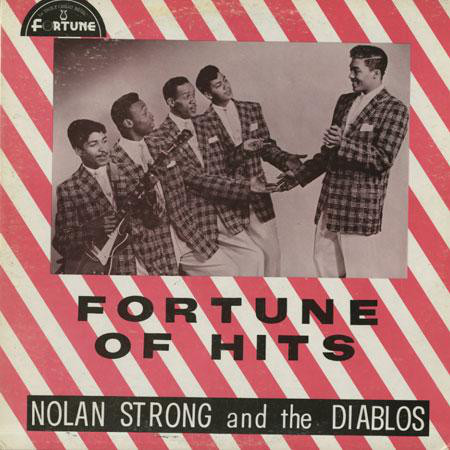
Label: Fortune Records – 8010 (LP)
Date: 1961
Composition: Jimmie Hodges (see note re Hugh Starr below)
B-Side: N/A
- This is the only track on Motor City Memories Vol. 1 that did not have a single release.
- It appears on the 1961 LP Nolan Strong and The Diablos – Fortune Of Hits. It is one of only two tracks on that album that did not have a single release (the other is “Ooh! Ooh! Those Eyes”).
- The group had released at least a dozen singles by the time the LP came out, so who knows why those tracks were chosen? “Ooh! Ooh!….” was written by Devora Brown, one of the owners of Fortune Records, so perhaps its inclusion was motivated by the publishing royalty.
- “Someday (You’ll Want Me to Want You)” has become a standard, recorded by many pop and country music singers. It is credited to Jimmie Hodges, although some sources say it was actually written by Hugh Starr.
- Nolan Strong and the Diablos were the biggest R&B group on Fortune Records. Fortune specialized in R&B, blues, soul and doo-wop music, although the label also released pop, big band, hillbilly, gospel, rock and roll, and polka records.
- The Diablos most famous song is “The Wind”, an original group composition that that has been covered by many artists (The Jesters’ version was also a hit; and Laura Nyro and Labelle included it in their wonderful 1971 homage to R&B, Gonna Take a Miracle).
- Fortune Records was run by a husband and wife team, Jack and Devora Brown, and were the antithesis of the well-oiled machine that Motown became.
- Fans of R&B and soul tend to get excited about Fortune Records. James Marshall, in his review of the aforementioned book about Fortune (Mind Over Matter: The Myths and Mysteries Of Detroit’s Fortune Records by Billy Miller and Michael Hurtt (Kicks Books)), enthuses about ” . . . the incredible body of knowledge, both historical, and mythological, found in this 552-page hardcover treatise on everything great to be found in postwar American popular culture. [The book] is the Rosetta Stone of rock’n’roll, and the greatest and most important book on popular music to be published in this century…maybe ever.”
- What the hell? Maybe it is.
Listening Notes:
- Solid R&B
- Spoken section with almost comic monotone
- Meandering somewhat ramshackle arrangement and mix (this is Fortune Records, remember?)
NEXT: I will at some point deal with Vol’s 2 and 3, although this work takes time!
Please like and share this post!
 Joel E. Turner - Fiction and Other Things
[…] NEXT: Here is link to review of Side 2! […]
LikeLike