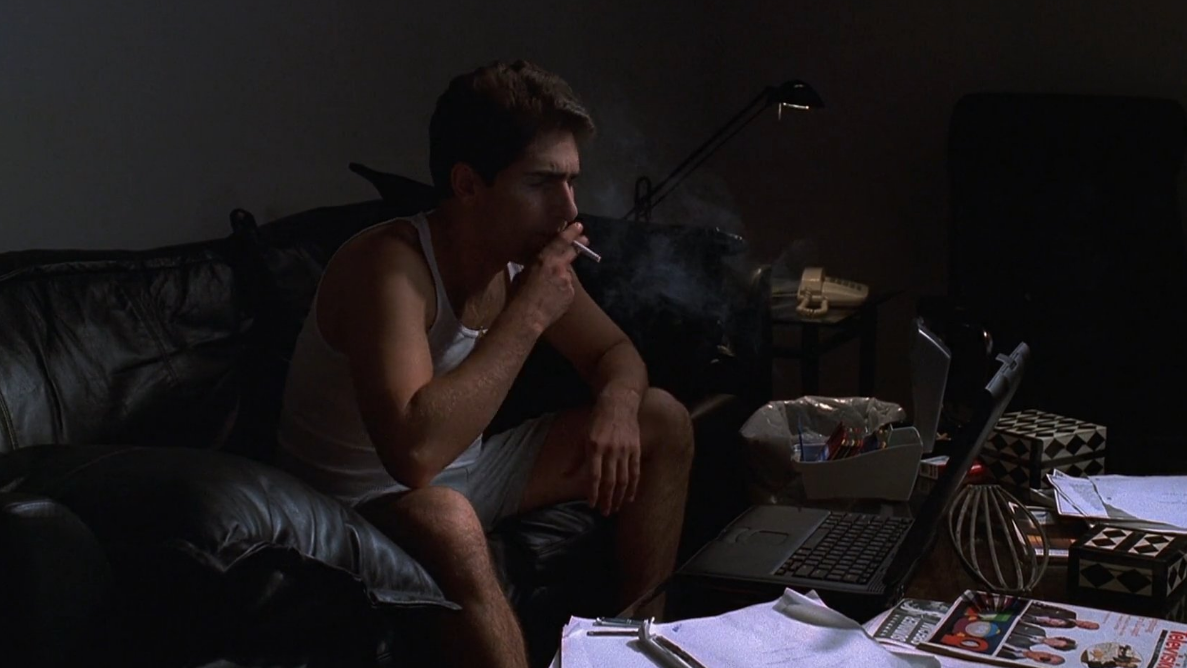
I’ve been reading Woke Up This Morning: The Definitive Oral History of the Sopranos by Michael Imperioli (Christopher Moltisanti on the show) and Steve Schirripa (Bobby Bacala) with Philip Lerman. The book was born out of the podcast Talking Sopranos hosted by Michael and Steve, and features interviews with many actors, writers, producers, directors and other crew members from the series.
There is lots of trivia and inside stuff for Sopranos fans but what interested me more was the talk about writing the show – and writing as portrayed in the show.
Chapter Seven, “Inside the Writer’s Room”, gives a feel for how the writer’s room functioned. A lengthy conversation with Robin Green and Mitch Burgess, who wrote twenty-two episodes, details their approach to story structure: organizing a story into two or three plots and working out “the beats” of each plot..
Mitch: The beats are the scenes that tell the arc of the story. In The Sopranos, there would be an A story, a B Story, a C story, most of the time.
Michael: …so the A story would have maybe eighteen beats, twelve for the B story, and maybe six for the C.
Robin: A beat is really a scene. It’s a necessary scene to tell the story. It’s not shoe leather. It’s not “he went here and he went there”.
Mitch: You never write a script without a beat sheet, which is all the beats written out and explained.
Robin explains how The Sopranos had more of a movie structure than is commonly seen in TV today:
Robin: Network TV now has five acts… a teaser, then you have your four acts. The Sopranos was more like a move structure. A three-act structure. You had your first-third setup, then the second third things got to a crisis point, then you have the resolution.
You beat out the stories separately, the A, B and C….Then I used to print them all out on paper and I would cut the paper with scissors, then . . . rearrange the strips of paper to meld them into one script.
There’s lots more in the book for writers or those interested in how the process works.
Terry Winter was another key writer for the show, authoring twenty five episodes, before going on to Boardwalk Empire and Vinyl. He also wrote The Wolf of Wall Street, which I recently (attempted to) watch for the first time. I thought it was terrible, but I guess even the greats (Scorsese) lay an egg every now and then.
Terry tells a story about how he got an agent and kick-started his career:
Terry: You can’t get a job without an agent and you can’t get an agent without a job, so how the fuck does anybody do anything.
I went . . . to the Writers Guild and they happened to have a list of agents who would take unsolicited scripts. On this list is a guy that sat five seats away from me during law school.
Terry calls the guy who says that he’s a real estate lawyer in Long Island who had a client that wrote a book on real estate, so the guy got bonded as an agent.
Terry: He goes “I don’t know anything about being an agent”. I said, “You sound perfect. You’re my agent now.” I created an agency out here [LA] with a mail box, phone mail system, address, letterhead.”
Note to writers: Don’t try this at home.
There are multiple conversations about an actor finding out that their character was going to be killed off – which generally pissed them off, as that meant their job was done. Sometimes David Chase, the creator and primary writer, made a point of visiting the soon-to-be-whacked actor and delivering the message personally, which echoes the many portrayals of the interaction between an apologetic gunman and an unfortunate victim (“nothing personal, it’s just my job, hope you understand”).
Terry Winter recounts his first day on the set, when he has a conversation with Tony Sirico, who plays Paulie Walnuts:
Terry: First thing, literally on day one, Tony Sirico comes up to me . . . “You’re the new writer. Let me tell you something. You ever write the script where I die, first I die, then you die…I’m telling you, don’t fucking think about killing me.’”
Nice. Of course, it is well known among Sopranos fans that Tony was pretty close to the real deal – practically a true wise guy.
There is a good amount of conversation with David Chase, who is a great writer. He comes across as someone who knew what he wanted to do, and after many years working in the industry, was going to make the show the way he wanted to. As he recounts:
David: [I wanted to make a show with] a slow pace if you wanted it. A comedy mixed with drama. Language like people speak. Believability in the way conversations happen, which is: people very seldom say what they mean; they say something else.
I am a great admirer of David Chase, and recommend Not Fade Away, a film he made about a kid, Doug (played by John Magaro), who joins a rock band in the mid-1960s. James Gandolfini plays his father.
Here’s the trailer for the movie:
Needless to say, they got me with the lead character studying The Stone’s 12 X 5.
Doug fully embraces the emerging image of the rock-musician-as-serious-artist. At a family barbecue, Doug is dressed in his Cuban heels and rock guy togs while his dad bemoans Doug’s pursuit of his music dreams rather than going to college. Doug’s aunt makes a trying-to-be-nice comment about “rock and roll – keeps you young, right?” To which Doug replies, “Does Dostoyevsky keeps you young?” Because he’s a serious artist, get it?
Doug is the drummer but becomes the lead singer after the original singer, Gene, accidentally swallows a joint while trying to smoke it through a toilet paper roll, and is unable to sing.
There are other references by band members to The Egyptian Book of the Dead, and a roach clip that someone left at Oberlin. I’ve told my kids that the movie really creates the feel of what is like growing up then. They were not impressed.
Anyway, back to David Chase, who made this interesting comment:
David: I used to say [at the networks], “Why don’t they just take ten percent [of all their programming] and call that research and development, and make weird shows or shows that they’re scared of or whatever?’“
I’ve thought the same thing about the publishing industry. I suppose some of the small publishers do this; but the large publishers might benefit from this equivalent of portfolio diversification.
Chase goes on to comment on some of the bad experiences he’s had in the TV business:
David: Somehow those people know how to find just the thing that you really want, that you really love, and go, “Why did you have to do that?” I don’t know how, but they have an unerring instinct for picking the one thing that was the whole reason you were writing for. You know what I mean? They smell it.
As if anyone needed reminding of the way Hollywood destroys writers’ dreams.
Of course, writing becomes a theme in the series, as Christopher attempts to write a screenplay. He is at a low point, having bought a program to help him write it that doesn’t seem to do the job. He is disconsolate when Paulie pays him a visit in Episode 8 of Season 1 (The Legend of Tennessee Moltisanti):
Christopher: It says in movie-writing books that every character has an arc, understand? Everybody starts out somewhere and then they do something…it changes their life. That’s their arc. Where’s my arc, Paulie?
Paulie: Kid…I got no arc either. I was born, grew up, spent a few years in the Army, a few more in the can. And here I am. A half a wiseguy. So what? You know who had an ark? Noah.
Perhaps a brave MFA program could put Paulie on a pro/con panel focused on this key writerly concept.
Here’s a longer clip of their literary discussion:
Continuing the calling-bullshit-on-lit-concepts theme, this exchange between Michael and Steve in their book got a laugh out loud from me. Steve is quizzing Michael about his writing career (remember, Michael is a writer – he did several Sopranos episodes and has written a couple of screenplays):
Michael: “I have a story in another book . . . The Nicotine Chronicles . . . it’s a magical realist allegory about colonialism.”
Steve: “I didn’t understand one fucking thing you just said.”
Truth!
 Joel E. Turner - Fiction and Other Things