
Hammer’s The Mummy (1959) features the same writer/director team (Jimmy Sangster and Terence Fisher) and male stars (Christopher Lee and Peter Cushing) as Hammer’s Dracula; and evokes with its title another Universal classic, The Mummy (1932), starring Boris Karloff. Its plot, as with Hammer’s Dracula, strays a good bit from the Universal version, in this case being more related to later Universal efforts in the 1940s, The Mummy’s Hand and The Mummy’s Tomb.
In both the original Universal and the Hammer versions, the central character is a high priest of an Egyptian cult 4000 years in the past, Imhotep in the Universal version and Kharis in the Hammer version, who has been mummified alive and made to stand guard over a dead Princess, whom he loved and attempted to bring back to life, thus violating a cultish taboo.
In both versions, the high priest is brought back to life by bumbling Anglo archeologists who read aloud things they should not, but in the Universal version, Imhotep (Boris Karloff) manages to take on an identity as an Egyptian historian named Ardeth Bey, which enables him to search for the reincarnation of his princess; whereas in the Hammer version, Kharis (Christopher Lee) remains mummified and comes under the control of an Egyptian still faithful to the old religion, Mehemet Bey (George Pastell), who is on a mission to kill the poor schmucks who disturbed the tomb.
This means that Christopher Lee, unlike Karloff, is shown exclusively in mummy wraps, except for early in the film. Here he is before and after his mummy make-over:
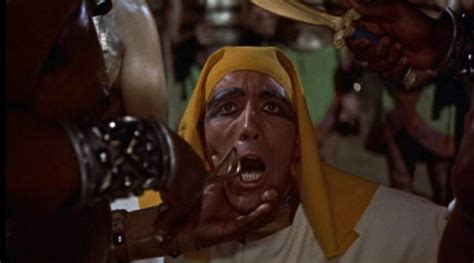
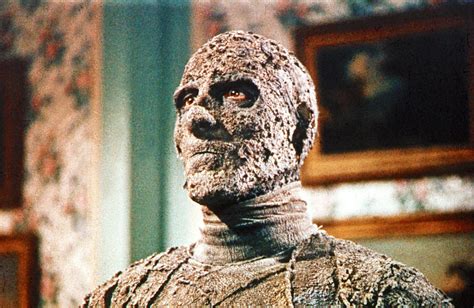
Kharis looks pretty upset on the left, but then you would too if your tongue was about to get cut out.
I do prefer the Universal version. It is slower in pace, and less blood-spatteringly horrific than the Hammer version, but what would you expect?
Still, the Hammer version has impressive moments of technicolor horror. The trailer doesn’t mind spoiling things a bit to ensure that potential viewers know there won’t be just the usual ineffective gunshots employed to bring Mummy down, but that we’ll have a Cushing/Lee moment involving a spear that penetrates and exits the wadding that encases the Mummy’s torso. (Further spoiler: the spear does not do the job either).
The voice-over narration to the trailer conveys the strange, blasphemous horror that awaits us:
“Egypt 4000 years ago . . . a land of strange rituals and savage cruelty . . . many of their secrets are still hidden from eyes of 20th century man . . .secrets that protect their dead . . . supernatural powers that once released can live again in our modern world.
“The Mummy, the living dead, bringing terror and death across four thousand years . . .he was a high priest of the great god Karnak until one night he attempted the ultimate in blasphemy . . .he was condemned to guard forever the princess he had loved and protect her from intruders . . .
“The Mummy . . Guardian of the Dead . . . Terror of the Living!”
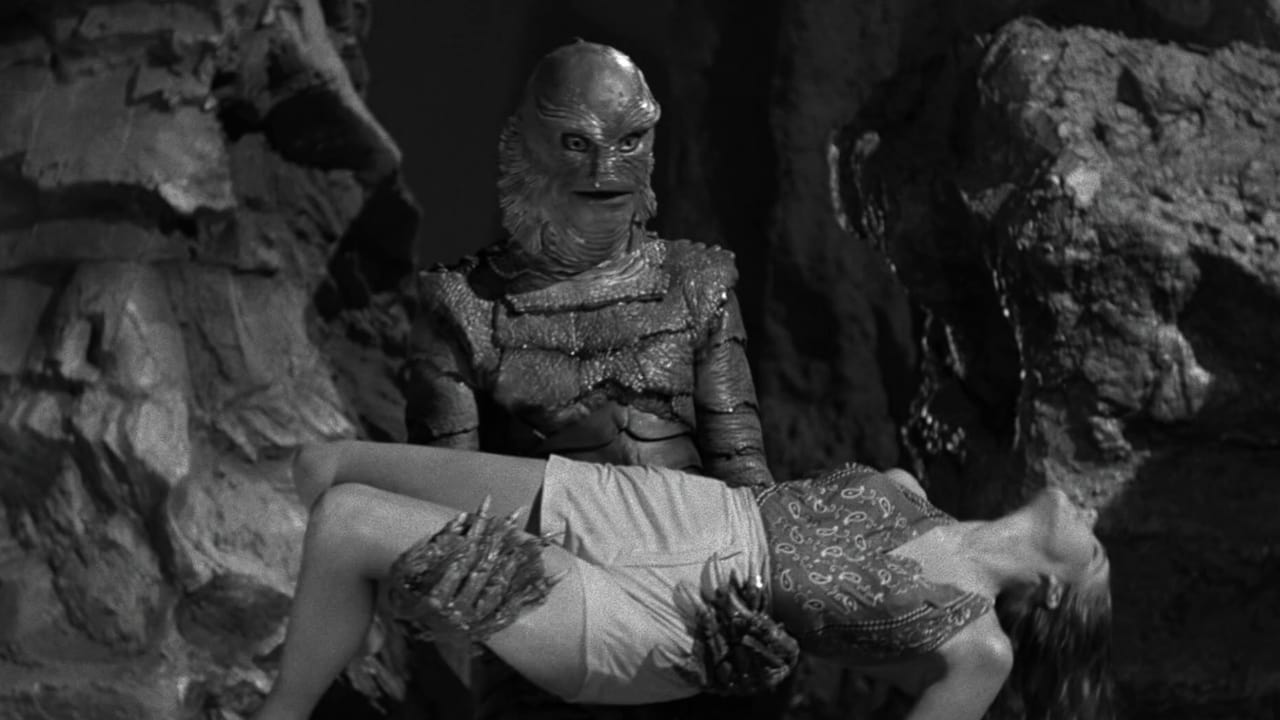
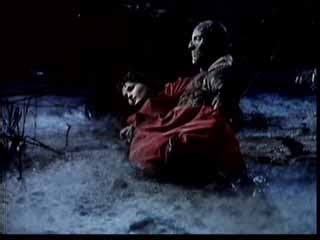
There is also a lot of activity in a swamp, as the Mummy has taken refuge there, bringing to mind The Creature from the Black Lagoon. Here’s the Creature (left) and the Mummy (right) in said aqueous milieus, bearing their chosen ones.
Both versions have dark-haired beauties who play the princess and her reincarnation. Here we have Universal’s Zita Johann and Hammer’s Yvonne Furneaux.
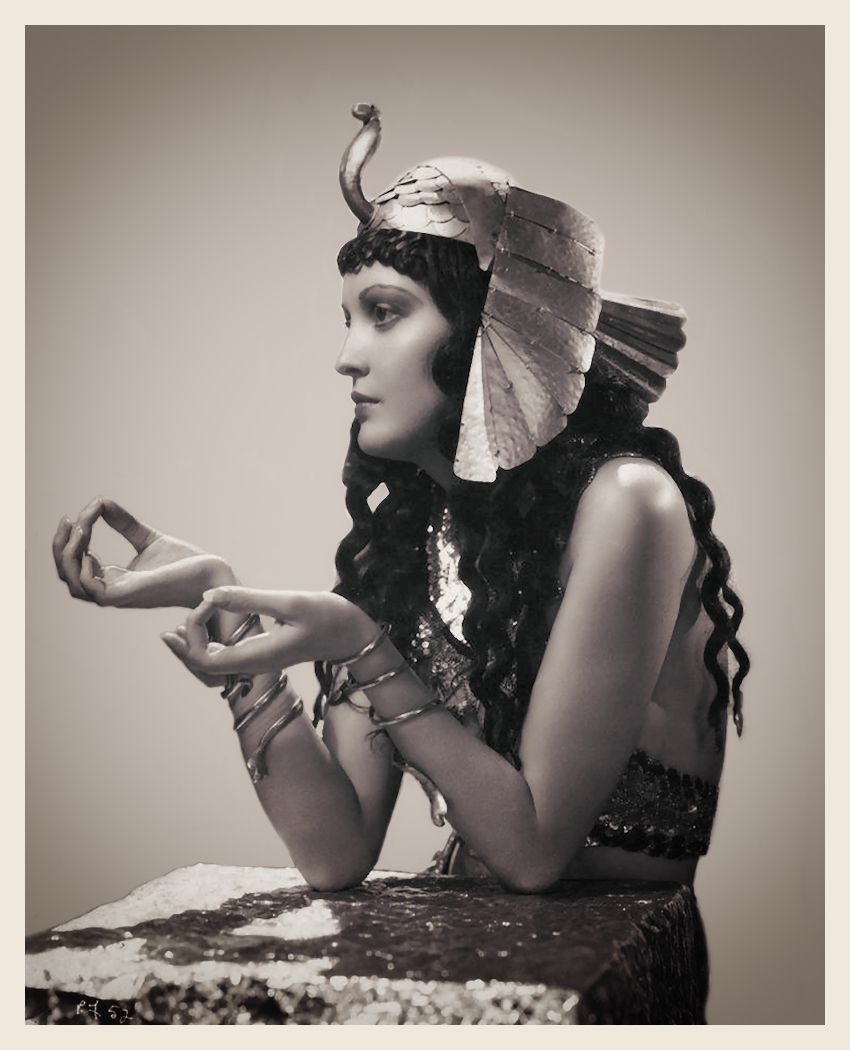

Neither looks remotely dark-skinned enough to be Egyptian.
Zita was Hungarian by birth, and appeared in a handful of movies in the early 1930s, then was absent from the screen for fifty years, until she was cast in a zombie movie in 1986 (Raiders of the Living Dead – the title tells it all – I can just hear the pitch now: “It’s Raiders of the Lost Ark meets….”). She did stage work in the 1940s, then devoted herself to charitable works among the physically handicapped, according to The Independent‘s obituary, which also mentions that she was a self-confessed mystic who claimed to levitate.
Yvonne, despite her Frenchified name, was not French at all, although she was born there as Elisabeth Yvonne Scatcherd. Her father was a banker from Yorkshire and her mother was from Devon. Nonetheless, the European stamp seems to be reflected in her work with Fellini (La Dolce Vita), Antonioni (Le Amiche) and Polanski (Repulsion). She did some artsy work (e.g., Peter Brook’s The Beggars Opera) and a slew of adventure and horror titles.
The two women fit the image of their respective Mummy studios and times: Zita being slender and vampish; and Yvonne tending toward the voluptuous.
Overall, The Mummy delivers what one expects from Hammer.
In our penultimate review in this series, we will enter the world of . . . well, let’s just say it’s a mashup of kaiju, Planet of the Apes, and kung fu, with a three-minute serenade to a monster. This is the world of Godzilla vs Mechagodzilla (1974).
 Joel E. Turner - Fiction and Other Things