Ok, I know it’s not Halloween anymore. But these things take time.
This epic can more properly be described as a Monster Movie, or kaiju film as they call it in Japan, rather than a horror movie. It is a sort of mashup of kaiju, Planet of the Apes, and kung fu, with a three-minute serenade to a monster.
Everyone knows who Godzilla is. But Mechagodzilla? He is, of course, “a robot designed by aliens to conquer Earth, [an] enduringly popular villain”, as The Criterion Collection folks describe him in the notes accompanying their release of the film.
Now all you cineastes can feel relieved. I mean, if the freaking Criterion Collection has gone to the trouble of “curating” this multi-monster fight-fest, then there’s no need to hide your adoration of it from your Truffaut-loving friends.
Here’s the real guy and the pretender facing off:
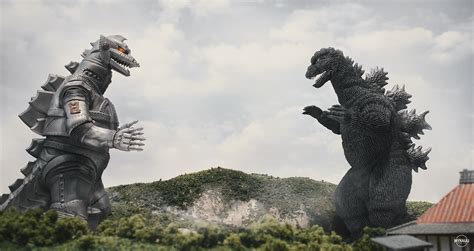
Godzilla vs. Mechagodzilla is the 14th Godzilla film (out of 38) and was the penultimate film of the Shōwa era, named after the historical era associated with the reign of Emperor Hirohito. All Japanese monster movies (kaiju eiga) are grouped into four eras, of which Shōwa is the first.
Godzilla vs. Mechagodzilla was released in Japan in 1974 and first appeared in the US in 1977 as Godzilla vs. The Bionic Monster, which was shortly changed to Godzilla vs. The Cosmic Monster. Other titles include Godzilla vs. Cyber-Godzilla, the Destruction Machine (Spain), MechaKing Against Godzilla (Mexico), Godzilla vs. the Robot (Italy), Terror of Mechagodzilla (Poland) and Godzilla Against the Mechagodzilla (Hungary).
The action begins when an Azumi priestess has a vision of a city being destroyed by a giant monster, while an archaeologist uncovers a chamber filled with ancient artifacts and a mural bearing an ominous prophecy: “When a black mountain appears above the clouds, a huge monster will arise and try to destroy the world; but when the red moon sets and the sun rises in the west, two monsters shall appear to save the people.”
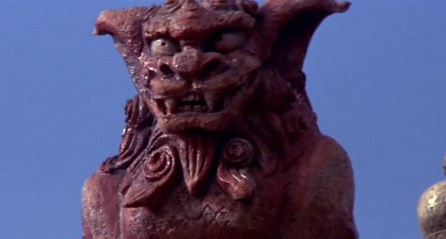
The chamber happens to contain a statue of Okinawa’s guardian monster King Caesar:
Meanwhile, a scientist (the archaeologist’s brother) discovers a type of metal not found on Earth while spelunking and takes it to a professor for examination.
When the black mountain/cloud appears, Godzilla (or what everyone thinks is the big G) emerges from Mount Fuji and begins a destructive rampage, contrary to his reputed tolerance for humans. Godzilla’s ally, Anguirus, confronts “Godzilla”, only to be nearly killed and forced to retreat.
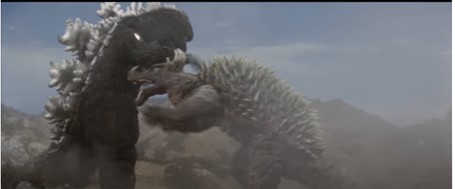
Anguirus deserves special mention, as it was the first monster to fight Godzilla, in Godzilla Raids Again (1955), the second film in the Godzilla franchise. As these things go, the two have patched it up, which makes Mechagodzilla’s (still in the G suit) savage treatment of Anguirus hard to fathom on first viewing. It really is pretty gory:

There is a definite WWE feel to the monster battles, with Mechagodzilla clearly embracing the heel role. I do not know when the franchise transitioned into a style wherein the combatants really look like a couple of guys dressed up in rubber suits throwing each other around. I suspect it goes along with the advent of color vs black and white.
Godzilla’s rampage continues until another Godzilla (the real one) emerges and battles it.
Confusion reigns among the viewers of this battle, until the real G blasts away the fake skin of the fake G…
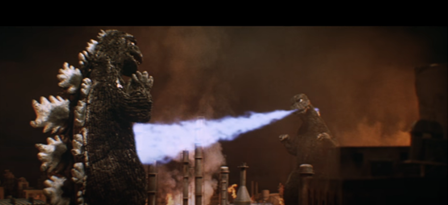
…to reveal Mechagodzilla, a massive robot armed with advanced weaponry made of space titanium (the non-earthly metal discovered in the spelunk).
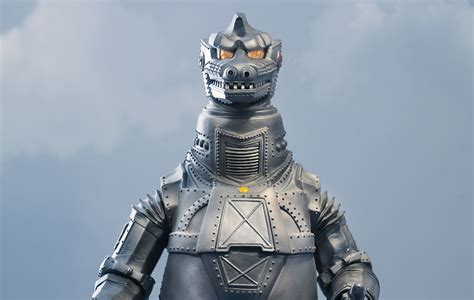
Godzilla is severely wounded, but inflicts some damage on Mechagodzilla before both monsters retreat.
The two brothers take the King Caesar statue back to the temple, where they are accosted by a man who attempts to steal the statue from them. During the fight, the skin on half of the villain’s face melts away, revealing an ape-like visage, before he is killed by an unseen gunman:
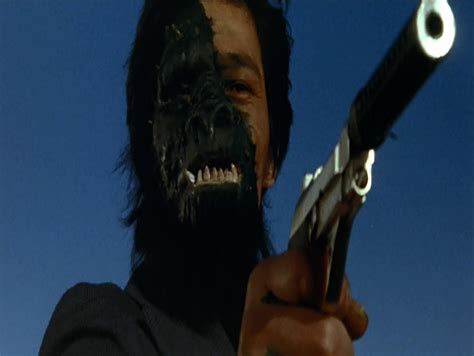
Concurrently, Godzilla arrives on Monster Island during a thunderstorm and is struck by lightning multiple times, reinvigorating itself.
The scientist, the professor and the professor’s daughter explore the cave where the space titanium was found, and are captured by ape-like aliens, who turn out to be from the Third Planet of the Black Hole. The Third-Planet-of-the-Blackholians plan to use Mechagodzilla to conquer Earth and force the professor to repair Mechagodzilla.
The unseen gunman is revealed to be an Interpol agent who has been tracking the aliens. He teams up with the archaeologist and they take the statue of King Caesar to the temple where the priestess hangs out.
The next morning, a lunar eclipse results in a red moon and a mirage of the sun rising in the west. Seeing this, the team realizes they have to awaken King Caesar (who will be the second monster per the prophecy).
They set the statue up and, activated by the red moon/mirage, it emits a ray directed at a rocky cliff where King Caesar slumbers, as depicted in the sequence below:
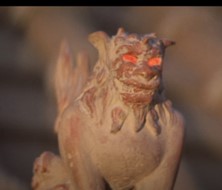

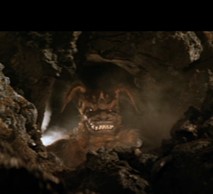
The problem is, King Ceasar is sleeping. As the high priest explains: “King Caesar can only be woken up by a direct descendant of the Azumi Royal Family.”
This is of course the priestess, who scampers on to the beach and sings a lovely song that will awaken King Caesar. The song is a full 2:30 and must have hit the Japanese charts, with its oddly Italianate orchestration:
That’s King Caesar above, by the way.
The song works, King Caesar is awakened and Godzilla and the Mecha dude appear. The two good-guy monsters prevail, the gorilla-aliens are destroyed, Godzilla heads out to sea and King Caesar returns to its resting place.
Here are the three combatants poised for the final battle:
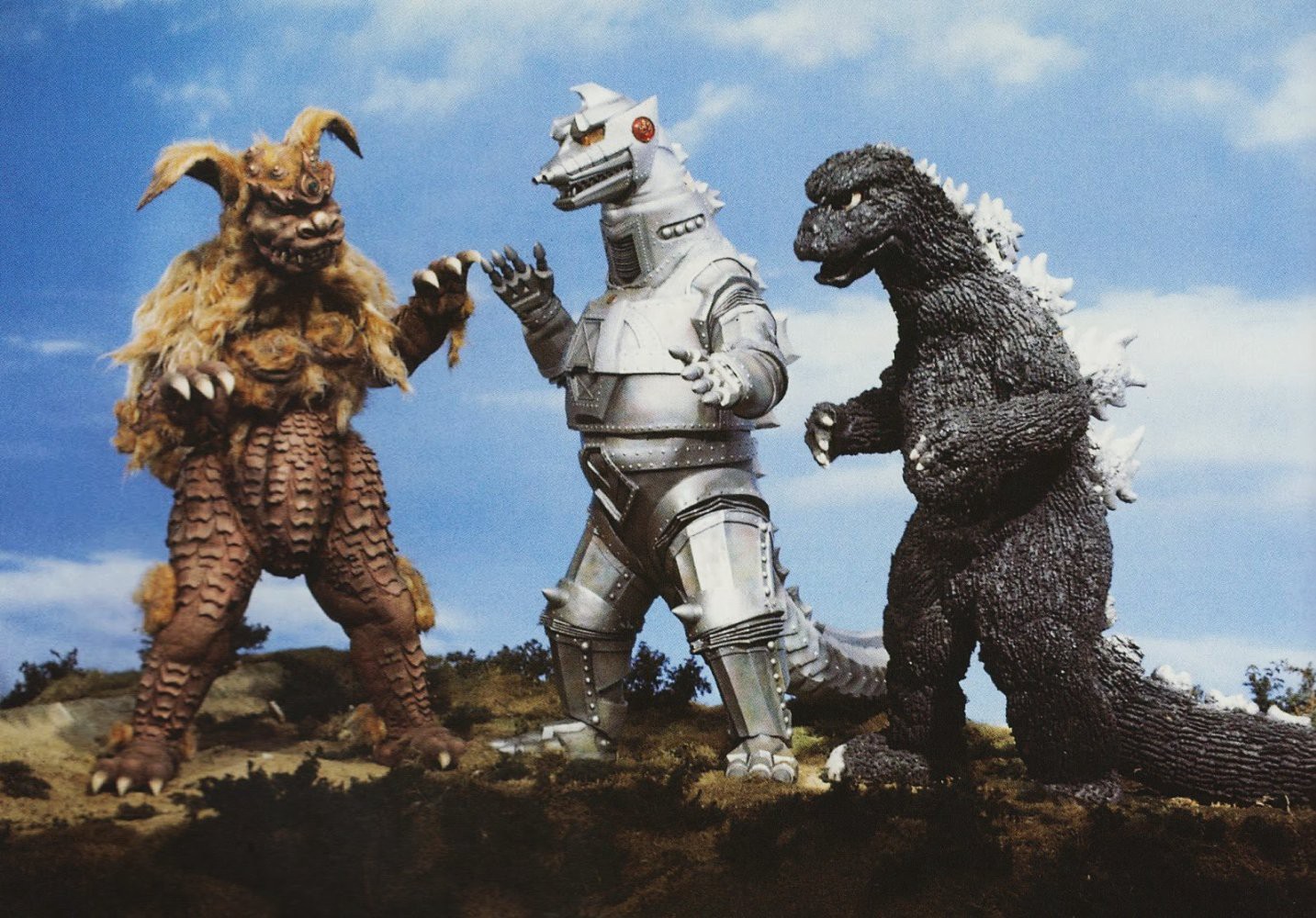
King Caesar is an interesting monster, being based on stone lion statues common in Okinawa. According to Wikipedia,”Shisa only loosely resemble actual lions on account of being based on second-hand descriptions by people who had never seen one in person. Character profiles in supporting media describe the monster as standing 50 meters (164 feet)-100 meters (328 feet) tall and weighing 30,000 tonnes (33,069 short tons)-50,000 tonnes (55,115 short tons). King Caesar is shown to be swift and athletic. It can also draw an enemy’s energy weapons into its right eye and reflect them back from its left eye with ten times the force, and empower itself with solar energy.”
The animation and fanzine-like projects that center around the Godzilla franchise are multitudinous and include an animated musical version of Godzilla vs. Mechagodzilla by LHUGUENY on Youtube. It runs about two and a half minutes:
More to my taste is a stop-motion animation rendition of the essential battles of the movie, put together by the Stop Motion Battles folks (eleven minutes or so):
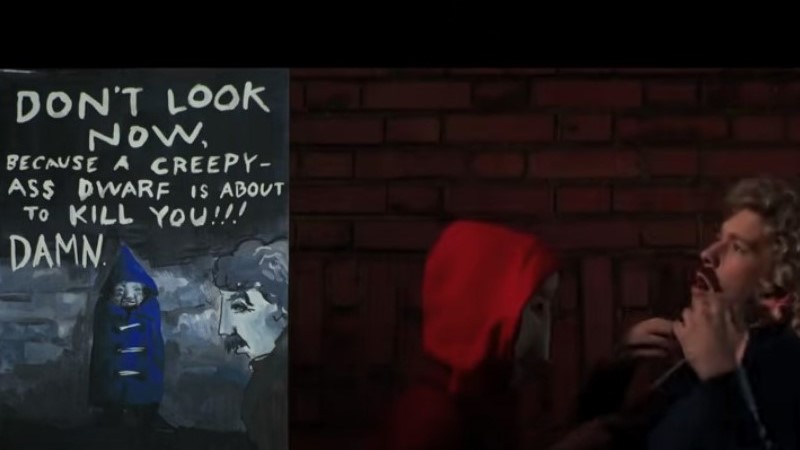
It puts me in mind of the film Me and Earl and the Dying Girl, in which two characters make cheap parodies of many films, including this Roeg classic:
My apologies to any true kaiju aficionados for my amateur effort at describing this classic. And I freely admit to cribbing much material from Wikapedia, which I have only referenced when direct quotes are used.
The final installment in this much-delayed series on Halloween horror will focus on the great James Whale’s Bride of Frankenstein.
 Joel E. Turner - Fiction and Other Things
I remember a dining room scene from the author’s youth, where our father angrily derided the author and another younger brother for their enthusiastic discussion of material like this article’s. At the time, Dad was not quite hip enough to appreciate the quality of the banter.
LikeLike