Newaygo is a town in rural western Michigan where you can buy t-shirts that say “Newaygo – a drinking town with a fishing problem”. It’s a small old-fashioned town on the Muskegon River that does a lot of trade with folks engaged in outdoor recreation – tubing, kayaking, fishing, hunting, hiking – or just hanging out in the North Woods and drinking beer. It is a great place but not exactly Greenwich Village.
So, it was surprising to go into a bookstore in Newaygo and find a cache of issues of the Evergreen Review. I purchased this particular issue on the basis of its table of contents:
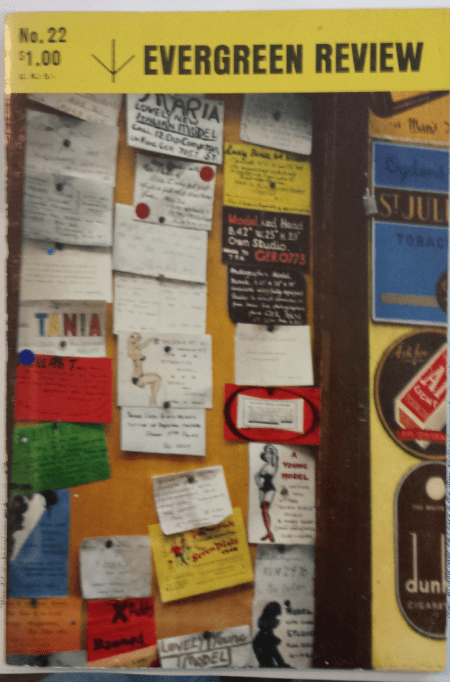
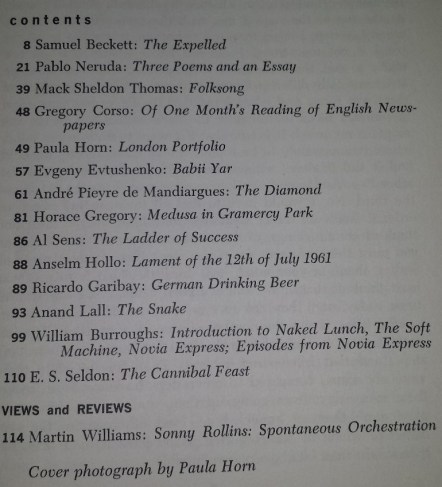
Ok, they got me, if it starts with Beckett and ends with Burroughs, I’m there. I’m a Burroughs fan from way back; in fact I did my honors thesis in college on Burroughs, which pretty much convinced me I was not cut out for academia. My scholarly method was to insert an excerpt from, say, The Ticket that Exploded, and point out how cool it was. And then, of course, go on about how it all related to McLuhan and John Cage.
Anyway, after a week, I took the issue out of its plastic sleeve (I’m a dilettante collector, so don’t have many things in protective sleeves; exceptions being an early edition of Candy and a vintage Blondie comic).
The issue had many mysteries between its covers. For example, look at the table of contents, p. 99: “Episodes from Novia Express”.
Mystery #1: Whence Novia Express?
Fans of Burroughs will be familiar with his novel Nova Express. It was the third novel published after Naked Lunch, and made extensive use of his cut-up or fold-in technique.
I had never heard of it being called “Novia Express”. This excerpt was published in 1962, before Nova Express was published by Grove Press in 1964. (Evergreen Review and Grove Press were both enterprises of Barney Rosset). I thought it might be a typo in the TOC, but “Novia” is used throughout.
“Nova” certainly works as a title on all sorts of levels for a Burroughs work, evoking exploding stars and a race to destruction. But “Novia”? As you might guess, there is a pretty extensive cottage industry of Burroughs fan-folks, bibliographers, hagiographers, whatever. I did a bit of searching, but did not find anything that explained how this change took place, or what Novia might mean.
There’s probably a Ph. D. thesis there for the taking.
Mystery #2: Who is E. S. Seldon?
He is the author of the review of Naked Lunch appearing in this Evergreen issue (“The Cannibal Feast”). A nice review, and I wondered who he was: another dead end. He is not listed in the contributors’ notes (which includes a description of Mack Sheldon Thomas as “currently serving a twenty-two-year jail term in Texas for a narcotics violation”).
Back to the internet, where I found three references for Mr. (?) Seldon. One is a review (favorable) he wrote in the Hudson Review of a Grove Press collection of writings by The Marquis de Sade:
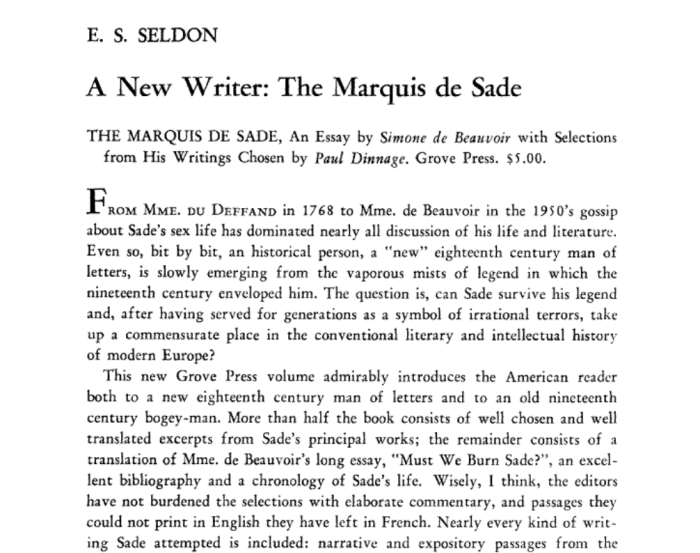
To access this, I had to sign up for the JSTOR database, which had all back issues of the Hudson Review online. Or, rather, all the articles from the back issues. I suspect that the actual magazine would have a contributors’ section, but that was not available on JSTOR.
UPDATE 11/10/2025: A reader (“N.N.”) informed me via a comment that the contributor’s section was actually available on JSTOR, and had this to say about Seldon: “E. S. SELDON has been at work for several years on The Universe of Sade.” I have found not been able to find any record of this book having been published.
There is a reference in a book dealer’s listing for a critical volume in German that includes an essay by Seldon, “Lolita and Justine”. Nabokov is another Grove press author.
He also shows up as translator of “Paris in the Twenties” (text by Armand Lanoux), a collection of jazz-age photographs.
Other than that, nothing. I do wonder if the name might be a pseudonym for someone in the Rosset/Grove Press camp.
Mystery #3: Who Won the 1962 MacMillan Novel Award?
Burroughs and Beckett notwithstanding, the ads in old publications are often more interesting than the editorial content (McLuhan creeping back in there). This ad caught my eye.
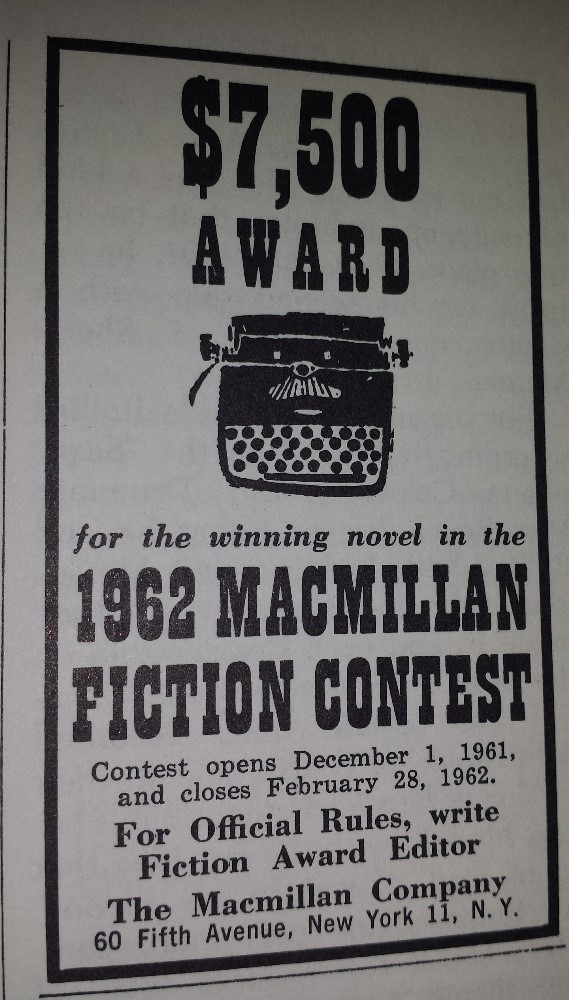
For any writers out there, that award would be about $60,000 in today’s dollars. Seen any writer’s contests today that are handing out that kind of cash?
I could find nothing about the MacMillan Fiction Contest in 1962 or any other year. MacMillan USA told me they don’t use the name anymore, they don’t have anything on the contest and the MacMillan used to belong to Simon & Schuster. S&S told me to check with MacMillan USA.
Perhaps I should have posed as a patiently waiting entrant to the contest: “Dear Sirs, I am just checking in to see if you have announced a winner to the 1962 . . .” Oh, well, we writers all know how slow publishers can be to respond (if they respond at all).
Update 11/10/25:
The same N.N. cited above also provided the following comment:
“The Macmillan (not MacMillan) Fiction Award was inaugurated in 1959, and the first three winners were:
1959: John Berry, Krishna Fluting
1960: David Storey, This Sporting Life
1961: Ann Hebson, The Lattimer Legend
But an extensive search of digital sources, including numerous paywalled ones, fails to come up with any information on the winner for 1962. Curiously enough, ads similar to this one for the 1963 award were published in late 1962 and early 1963, but the same applies to that year’s award as well. The following year, even the ads disappear.”
Mystery #4: Where Can I Get It?
That is the immediate question concerning this learned volume:
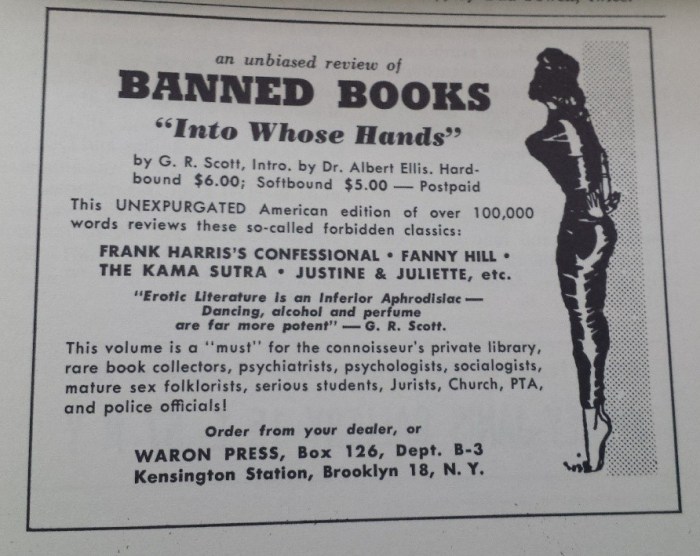
The full title of this important work is Into Whose Hands: An Examination of Obscene Libel in Its Legal, Sociological and Literary Aspects. I suspect Waron Press may have omitted the full title to avoid scaring away readers who were more interested in something “unexpurgated”. Or it may be that the longer title could not fit around the aggressively pointed, no-doubt-entirely-justified-by-the-exigencies-of-the-plot, bosom on the right-hand side without some serious kerning.
As a public service, I will let you know that a first edition of this volume can be obtained at a very reasonable price. The author, George Ryley Scott (1886 – c.1980), was, according to one description on Abebooks, “a prolific British author of books about sexual intercourse, active from the late 1920s to the 1970s. He also wrote on the subjects of poultry, health, corporal punishment, and writing itself.”
You wonder how many churches or PTA’s (furtively) ordered copies. And why are immature sex folklorists and non-serious (=all) students excluded from this pitch?
Those interested in poultry will have to wait for a future blogpost.
Mystery #5: What Happened Indeed?
From an ad for The Realist:

Wikipedia describes Young Americans for Freedom (YAF) as “an ideologically conservative youth activism organization that was founded in 1960 as a coalition between traditional conservatives and libertarians on American college campuses. The purposes of YAF are to advocate for public policies consistent with the Sharon Statement, which was adopted by young conservatives at a meeting at the home of William F. Buckley in Sharon, Connecticut, on September 11, 1960”.
So, to answer the question, yes, subversive.
The Rent-a-beatnik ads were the brainchild of Fred McDarrah, a famous photographer of the New York scene in the 1960’s, the first and for a while the only photographer for The Village Voice. According to his obituary in The Independent, “On a whim, he once put an ad in the Voice, urging readers to ‘Rent Genuine Beatniks – badly groomed but brilliant (male and female)’ to liven up parties. He meant the ad as a joke but the paper was inundated with requests and McDarrah enlisted artist friends, and sometimes beatniks off the streets of Greenwich Village, to ‘add a little colour’ to dinner parties around the Big Apple in return for a free mea’.”
You can view some of Fred’s work here: https://www.photos.com/prints/photographers/fred-w-mcdarrah.html.
Mystery #6: In what way does Molloy resemble √2?
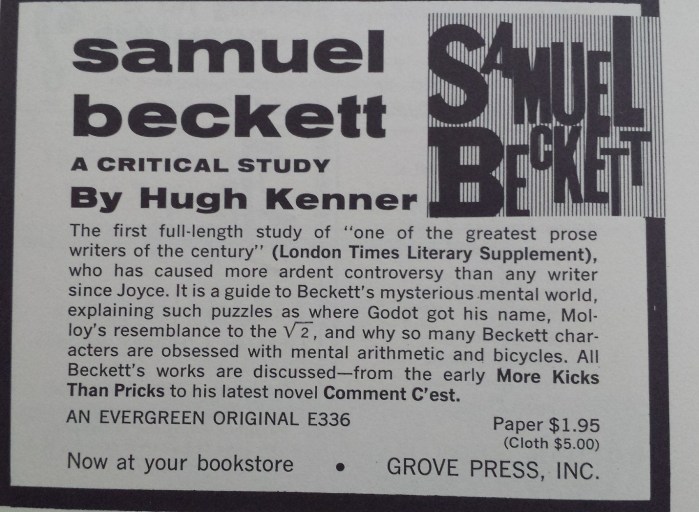
Kenner is great on the modernists. There is no end of arcane writings on Beckett involving math and science, but I think we can just leave it at both Molloy and √2 being irrational.
And finally…..
Mystery #7: What is Peter Cook doing on this bicycle?
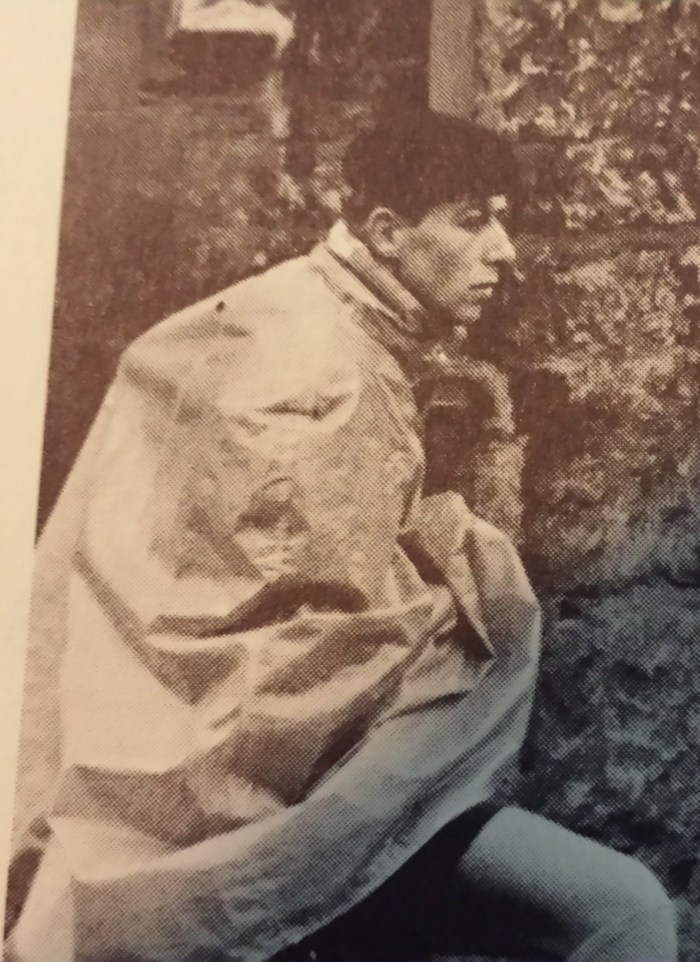
Note: All images are from Evergreen Review #22, except the image of E. S. Seldon’s review of A New Writer: The Marquis de Sade, which was captured from JSTOR.org,
 Joel E. Turner - Fiction and Other Things
WOW!! What a find!!!
flora.turner@verizon.net flora.turner@verizon.net
LikeLike
Whew. Lots of good stuff. Perhaps can comment more later. For now, here is one illustration of what happens when a writer retires from his day job.
Sup
LikeLike
Quite a rabbit hole this find lead you down! Loved the ad for ‘rent a beatnik” that was taken literally. This was a fun read just the thing to read as an antidote to watching the ever creepier episodes of Fortitude. Rc
Sent from my iPad
>
LikeLike
Will be going back to that bookstore. The guy who owned it originally was a real antiquarian/collector type. He sold the store and still does mail order. But I am sure he sold some of the inventory to the new owners. Besides the Evergreen Review, I got a hardcopy of Burroughs The Ticket That Exploded and a CD of Burroughs and Brion Gysin. Also saw things like The Story of O. So not exactly Legion of Decency approved material. Glad you enjoyed the note. Don’t know if I can do another Fortitude series, though enjoyed the last one. In our several years behind mode, we just started watching Justified. Also watched a ridiculous Irish comedy series, Bridget and Eamon, first season is funny.
LikeLike
On rent-a-beatnik: in the late 50s a guy named Hubert Leslie, known around North Beach as Hube the Cube, used to rent his services as a beatnik for society parties on Nob Hill in San Francisco. You can probably still find pictures of him on the Net. As I remember, his only qualifications as a beatnik were a pointy beard and a surly manner, but I imagine those were enough for the society folk.
LikeLike
Thanks for the tip, sounds perfect
LikeLike
Contrary to what you claim, the contributors section for the Summer 1953 issue of the Hudson Review is on JSTOR, as part of what JSTOR terms the “Front Matter” for that issue: https://www.jstor.org/stable/3847520?seq=6
It states: “E. S. SELDON has been at work for several years on The Universe of Sade.”
The Macmillan (not MacMillan) Fiction Award was inaugurated in 1959, and the first three winners were:
1959: John Berry, Krishna Fluting
1960: David Storey, This Sporting Life
1961: Ann Hebson, The Lattimer Legend
But an extensive search of digital sources, including numerous paywalled ones, fails to come up with any information on the winner for 1962. Curiously enough, ads similar to this one for the 1963 award were published in late 1962 and early 1963, but the same applies to that year’s award as well. The following year, even the ads disappear.
LikeLike
Thanks so much for the info. I should have seen that Front Matter in JSTOR. Your other information is very helpful.
LikeLike